Wednesday, May 28, 2008

Wild Roses

The wild roses, Rosa nutkana, are just beginning to bloom. There are literally acres of them on the island. When we first moved here we had to grub them out of the yard to beat back the jungle. They can grow 10 feet tall and spread by root suckers. Sort of like very tall quack grass with thorns.

They do redeem themselves in the spring. As soon as the new foliage opens the island is full of the rich spicy, rose smell of the plants, because not only are the flowers scented but so is the foliage. Particularly in the evening when the air cools down and is moist the scent is almost overpowering. The cats come in smelling like roses when they prowl under them in the spring. I used to gather big 5 gallon buckets full of the petals to make potpourris and my hands and hair and clothes would be full of the scent. Interestingly, none of the reference books I've ever seen mention this scented foliage characteristic of the plant although other wild species with scented foliage like Rosa eglantaria are listed as having scented foliage. The species grows all across North America and I wonder if all the plants have the scented foliage or if this is unique to this area.

Eagle

Here's our visiting eagle flying off after he'd landed next to the little chickens' pen. We woke up hearing the chickens yelling at him and heard him claw at the wire on the pen. Joel charged out and he (she) flew off but landed in a nearby tree giving me a chance to grab the camera. I'm not sure what we are going to do about this guy. I'm not willingly letting him have my chickens.

Tuesday, May 27, 2008

New chickens

My oldest daughter is a first grade teacher and this spring they hatched baby chicks in the classroom. Of course, after they were hatched she had to find homes for them so 10 of them came out here with her this weekend. They are Rhode Island Reds and a mixture of hens and roosters. We think 4 of them are hens for sure but it is really too early to tell as they are only about a month old. They seem quite happy in their pen. This is one of the "chicken tractors" that we move from place to place in the garden, letting the chickens scratch up the soil, eat bugs and fertilize for us. It also keeps them safe from owls, hawks, and eagles. And our visiting eagle was here at 5:45 this morning checking them out.

We started planting the warm weather crops today. Plants like corn, beans, and squash all need the soil to be at least 60 degrees before you plant them or the seeds rot in the soil. We planted the first corn today, 4 varieties with different maturity dates to give us a crop stretched over several weeks next fall. I also put the first zinnias in the ground. This is another plant that wants warm soil. Hopefully in the next few days we can get the first beans in the ground. We always start with brown seeded varieties as they are more tolerant of cool soil than white seeded ones.

Sunday, May 25, 2008

House Roses

The rose growing on our house in the post below and in the picture to the left is a Rosa banksia, a beautiful double flowering yellow rose that blooms once a year, in the spring. It is huge climbing rose that is covered each year with literally thousands of tiny flowers. It was a wedding present to us in 1986.

The picture of the house above was taken in the early 20's, and no, it isn't the same rose. However, the similarity is amazing. A few years ago we met the descendants of the people sitting on the porch, the Adrian family. They only lived here for a few years in the early 20's, and the story is that they ran a bootlegging operation out of the house during prohibition. The San Juan Islands, being close to the Canadian border were a hot bed of rum runners and this island was no exception. I believe that another family lived here in the 30's but after that it was essentially abandoned until Joel moved in in 1979.

Farm Scenes

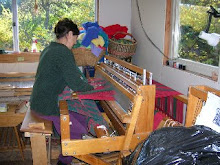
We have a whole bunch of family here for the long weekend and most of them spent a couple of hours this morning helping prepare a bunch of rag strips for weaving. I tear the strips from old sheets in appropriate colors and then remove the loose strings and cut the ends to a point so that I can overlap them when I weave. We got a huge bunch of them all ready to go. And it was fun to work on it with my children and grand children.
With the warm weather things are growing. The apple blossoms are blowing off the trees and carpeting the driveway matching the white daisies in the lawn.
And the oriental poppies are blooming. Big and bright they are my favorite poppies.

Tuesday, May 20, 2008

Last Daffodils

The Pheasant eye daffodil is usually the very last to bloom. Unlike other daffodils where the flower stem comes up with the leaves, the Pheasant Eye's leaves come up first leaving me to worry that they aren't going to bloom this year. But they usually do. A couple of years ago I got an old heirloom double Pheasant's Eye that blooms a week later. It is just now beginning to bloom. It's lovely to have a few daffodils left at this time of spring.

Monday, May 19, 2008

Apple Trees

The yard is full of flowering apple trees. Their scent fills the whole place. The last couple of days of warm weather has brought out lots and lots of native pollinators and the trees are humming with them. Above is one of the 6 100 year old apple trees in the yard that were planted at about the time our house was built. This one we call the Apple Pie Tree because noone has been able to identify it. The fruit is red striped and very tart and makes the best apple pies of any of our apples. We also make wonderful apple catsup from these apples.

In addition to the old apples we have planted 6 more apples mostly out around the pond.
And all over the place are dozens of wild crab apples, Malus fusca in the picture above. I think maybe one of the reasons we have such a healthy population of native pollinators may well be because of the abundance of these pretty wild trees. They provide lots of pollen and nectar for these insects. I'm not sure what they all are. If I look very closely at all the bugs in the trees there are a lot of different ones. I'm sure a lot of them are mason bees, which look like small bumble bees.

And there are also a lot of seedling apples trees in the woods, along the road, in the fields. Many of them come from a thrown apple core but some are also crosses between fruiting apples and the wild ones probably spread by the birds. The fruit on these tends to be bigger than the tiny wild ones, more like a modern crab apple, but not as big as a regular eating apple. Their flavor runs from awful to good. But the sheep enjoy all of them.